September 9, 2026 • Renata Solís • 11 min reading time • Specs verified June 5, 2026
Ankle Weights for Physical Therapy and Home Rehab: Fit, Comfort, and Safety First
Ankle weights are exactly what they sound like: small, weighted cuffs that strap around your ankle to add gentle resistance to leg movements. They’re a staple in physical therapy clinics because they let patients rebuild strength in small, controlled increments — a quarter-pound or half-pound at a time — without the joint stress of heavier barbell or machine work. If your physical therapist (PT) sent you home with a list of exercises — leg lifts, clamshells, terminal knee extensions — and told you to pick up a pair, you’re in the right place. This guide will walk you through what to look for in terms of fit, padding, and weight design, name the specific products that keep appearing in PT-referred buyer reviews, and help you avoid the one mechanical failure that frustrates otherwise happy users.
| EDITOR'S PICKAPEXUP Adjustable Ankle Weights… | Mid-tierThe Cuff Original Adjustable An… | Budget pickTHERABAND Ankle Weights | |
|---|---|---|---|
| Sold as | Pair (2 straps) | Single strap | Pair (2 straps) |
| Weight each | 5 lb | 5 lb | 1 lb |
| Total weight | 10 lb | 5 lb | 2 lb |
| Modular weights | ✓ | — | — |
| Color | Black | — | Red |
| Price | $29.95 | $29.80 | $18.99 |
| See on Amazon → | See on Amazon → | See on Amazon → |
Why So Many PT Patients End Up Buying the Same Brands
A striking pattern emerges when you read through hundreds of buyer reviews for ankle weights: a large share of buyers didn’t discover these products through a fitness magazine or Instagram reel. They arrived at the product page because their PT pointed them there directly. Across reviews for The Cuff, Henkelion, Sportneer, and APEXUP products, reviewers explicitly state phrases like “my PT recommended this” or “I bought this to replicate what we do in the clinic.” That’s not a coincidence — it reflects a real referral chain from clinical use to home purchase.
The Cuff brand earns particular credibility in this channel. Multiple reviewers across different platforms describe The Cuff as “identical to what my PT uses,” which is a meaningful signal. Per Verywell Fit’s overview of ankle weight selection, clinical-grade equipment tends to prioritize consistent weight distribution, durable closure systems, and materials that hold their shape through repeated extension cycles — all things that matter more in a therapeutic context than raw weight capacity. When a product earns that “same as the clinic” description from independent buyers who have no relationship with each other, it tells you the build quality is replicating a reliable standard.
ACE Fitness’s guidance on resistance training for rehabilitation emphasizes that load progression should be gradual and controlled, which is exactly why the adjustable, modular designs — where you can add or remove weighted inserts — have captured the PT-referral market. The ability to start at one pound and move to two without buying a second product is not just a convenience; it’s a clinical principle applied to consumer gear.
The Insert-Sliding Problem: What It Is and How to Manage It
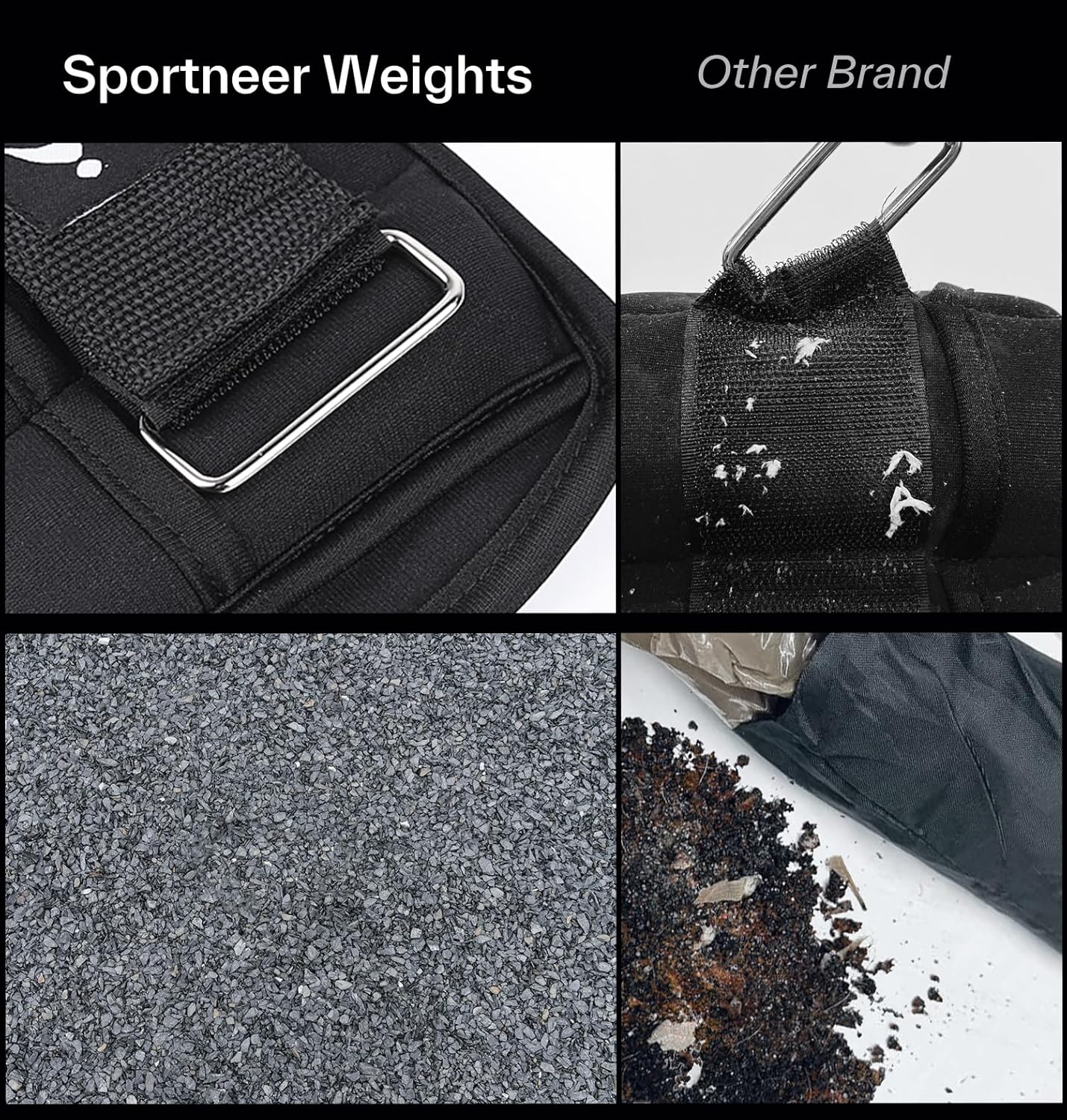
If you go with a modular adjustable ankle weight — the kind that uses removable sandbag-style inserts to let you dial in the resistance — you need to understand one recurring failure mode before you commit. A Sportneer reviewer described it clearly: the weighted inserts can slide or shift inside the cuff pocket during movement, creating uneven load distribution and a nagging sensation that something is wrong with your form when the problem is actually mechanical.
This isn’t a Sportneer-specific issue; it appears in reviews across the adjustable-insert category broadly. The root cause is pocket design: if the insert sleeve is slightly wider than the insert, or if the pocket mouth doesn’t seal tightly, normal leg movement during exercises like standing hip abductions or prone leg raises creates enough momentum to shift the bag.
Practical mitigation strategies reported by owners:
- Check pocket tightness on first use. Before a full session, load the inserts and do ten reps of your target exercise at half range of motion. If you feel the insert shifting, the fit is loose.
- Prefer designs with individual insert pockets over a single open channel. Multiple narrow pockets constrain each insert’s lateral movement.
- Snug the outer strap firmly. A looser cuff allows the whole weight assembly to rotate, which compounds insert movement.
- Fixed-weight cuffs eliminate this entirely. If insert migration is a dealbreaker for your exercise type — particularly anything with a fast extension or kick — the fixed-weight cuff design (a single sewn weight, no inserts) is the cleaner choice.
SELF’s ankle weight coverage notes that fixed cuffs trade adjustability for consistency, which is exactly the right tradeoff framing for a PT context where predictable resistance matters more than maximum range.
Padding, Softness, and the Populations Who Need Both
One underserved segment in most ankle weight buying guides is the population for whom padding softness is the primary criterion — not an afterthought. Two buyer populations make this point clearly in the review record.
Pediatric PT users. Reviewers purchasing ankle weights for children with autism and sensory sensitivities highlight the softness and safety of the outer padding as the single most important factor. A hard plastic buckle or stiff neoprene cuff is a non-starter for a child who is already managing sensory overload during a PT session. Products with thick foam or plush neoprene exteriors, rounded closures, and no exposed hard edges earn consistent approval from these buyers. Weight range is almost irrelevant — one to three pounds covers the full therapeutic range for most pediatric applications — but the tactile quality of the material determines whether the child will tolerate wearing it at all.
Arthritic and post-surgical users. Buyers managing arthritis or recovering from joint surgery describe similar priorities. Skin contact comfort across a full thirty-minute session, cuff material that doesn’t create pressure points on bony prominences, and a Velcro closure that doesn’t require significant grip strength to fasten — these are the decision variables that actually determine whether the product gets used consistently.
Per Shape’s coverage of ankle weight risks and benefits, improper fit is one of the primary causes of compensatory movement patterns during rehab exercises — meaning that a cuff that slips, pinches, or irritates will change the way you perform the exercise, potentially working the wrong muscle or stressing the wrong joint. Comfort and fit are not soft concerns; they are biomechanically consequential.
By the numbers — sizing reality check:
| User population | Practical weight range | Primary fit criterion |
|---|---|---|
| Post-surgery (early-stage) | 0.5 – 2 lbs | Padding softness, zero pressure points |
| Pediatric PT | 1 – 3 lbs | Tactile comfort, no hard edges |
| Arthritic maintenance | 1 – 5 lbs | Easy closure, uniform cuff pressure |
| General home rehab | 2 – 10 lbs | Adjustability, insert stability |
The Category-Blurring Crossover: Ankle Weights Beyond the Ankle
One of the more practically useful observations in the buyer review record is that these products don’t stay on ankles. A back-surgery patient following PT home-exercise instructions specifically called out using Logest soft dumbbells with Velcro straps as a wrist and arm weight — not as an ankle weight at all. The product’s soft construction and gentle closure made it usable for seated upper-body movements that would have been awkward or unsafe with a traditional hand weight.
This crossover matters for how you shop. If your PT has given you a protocol that includes both ankle and wrist resistance work — common in neurological rehab, post-stroke recovery, and some orthopedic upper-extremity programs — a product with a flexible cuff and secure Velcro may serve both applications. An APEXUP reviewer made a related point from the storage angle: modular ankle weights with removable inserts replace what would otherwise be multiple fixed dumbbell sets at different weight levels, saving both money and space. For a home environment where a dedicated weight rack isn’t feasible, that space-saving argument is legitimate and worth building into your purchase decision.
Velcro Durability: What the Long-Run Record Shows
Velcro is the closure system for virtually every ankle weight on the market, and it has a known failure mode: lint, fabric fiber, and dried skin accumulate in the hook side of the fastener over time, reducing grip strength. For a PT population that uses these products daily across months of recovery, this is not a hypothetical concern.
Verywell Fit’s ankle weight guidance recommends checking closure condition at the start of every session — a thirty-second habit that catches degraded Velcro before it fails mid-exercise. Signs that a closure is losing function include: the strap peeling back at low tension, the cuff rotating around the ankle during movement (a sign the hold is insufficient), or visible fiber mat buildup on the hook panel.
Practical maintenance: use a fine-toothed comb or stiff brush to clear accumulated lint from the hook panel every few weeks. Avoid washing the weights face-down in a laundry bag without folding the Velcro closed first — open hook panels collect lint aggressively in a wash cycle. Products with wider Velcro panels (more surface area) and reinforced stitching at the strap base consistently earn better long-run closure reviews than those with narrow straps.
Frequently Asked Questions
How do I keep ankle weight inserts from sliding out during exercises? Choose a design with individual insert pockets rather than a single open sleeve, and verify the fit by doing a few slow reps before committing to a full session. Cinching the outer strap firmly reduces cuff rotation that compounds insert movement. If insert stability is critical for your specific exercises — especially any fast-extension movement — a fixed-weight cuff eliminates the problem entirely.
What weight should I start with for post-surgery physical therapy? Follow your PT’s specific guidance first — they know your surgical site and tissue tolerance. In the absence of a specific number, the pattern in post-surgical buyer reviews strongly clusters around one pound as a starting point, with progression to two pounds only after several sessions at the initial load feel comfortable. ACE Fitness’s rehabilitation resistance guidance emphasizes that early-stage post-surgical loading should prioritize movement quality over resistance level.
Can ankle weights be used for wrist or arm exercises too? Yes, and it happens more than product descriptions suggest. Soft-construction ankle weights with pliable closures are used by PT patients for seated arm exercises, wrist resistance work, and upper-extremity proprioception drills. If you need resistance for both lower and upper body rehab movements, a soft-cuff adjustable product may serve both without requiring separate purchases.
Are these safe for children doing physical therapy? For pediatric PT applications, the primary selection criteria per the buyer review record are soft outer materials with no exposed hard edges, and weight ranges that top out at three pounds or below. Products with plush neoprene or foam padding and rounded closures are consistently preferred by parents purchasing for sensory-sensitive children. Consult your child’s PT before introducing any resistance — the clinical professional supervising the program should confirm both the product type and the starting load.
How do I know if my ankle weight Velcro will hold through an entire session? Test closure strength before the session by fastening the cuff and trying to peel the strap back with moderate hand pressure. It should resist cleanly. During exercise, any cuff rotation around the ankle indicates insufficient closure grip. Check the hook panel for lint buildup — accumulated fiber is the most common cause of progressive closure failure — and clear it with a stiff brush every few weeks.
What is the difference between a fixed-weight cuff and a modular sandbag ankle weight? A fixed-weight cuff is a single unit with the resistance sewn into the cuff permanently — no removable parts, no insert migration, consistent weight every rep. A modular sandbag design uses removable weighted inserts (small bags of iron sand or steel shot) that slide into pockets in the cuff, letting you adjust total resistance by adding or removing inserts. Fixed cuffs win on simplicity and reliability; modular designs win on adjustability and long-term value. For PT use where gradual progression matters, modular designs are generally preferred — with the caveat that insert stability requires attention to pocket fit and cuff snugness.
The Decision Rule
If your PT gave you a specific brand name, start there — clinical referrals reflect hands-on familiarity with the product’s build quality that no review aggregation can fully replicate. If you’re choosing without a referral: for post-surgical or arthritic populations where padding softness is the primary variable, prioritize a fixed-weight cuff with plush neoprene and wide Velcro over any adjustable design. If progressive loading is the priority — you need to add resistance as you recover — go modular, but verify the pocket design constrains insert movement before committing to a full session. For pediatric PT, padding material and edge safety are the only variables that matter at the weight ranges involved.
The goal is consistent execution of your PT protocol across weeks and months of recovery. The product that stays comfortable, holds its weight where it belongs, and closes reliably every time you strap it on is the right product — regardless of what tier it sits in.