August 2, 2026 • Renata Solís • 8 min reading time • Specs verified June 5, 2026
Rubber Hex Dumbbell Sets: Per-Pound Value Math for the Home Gym
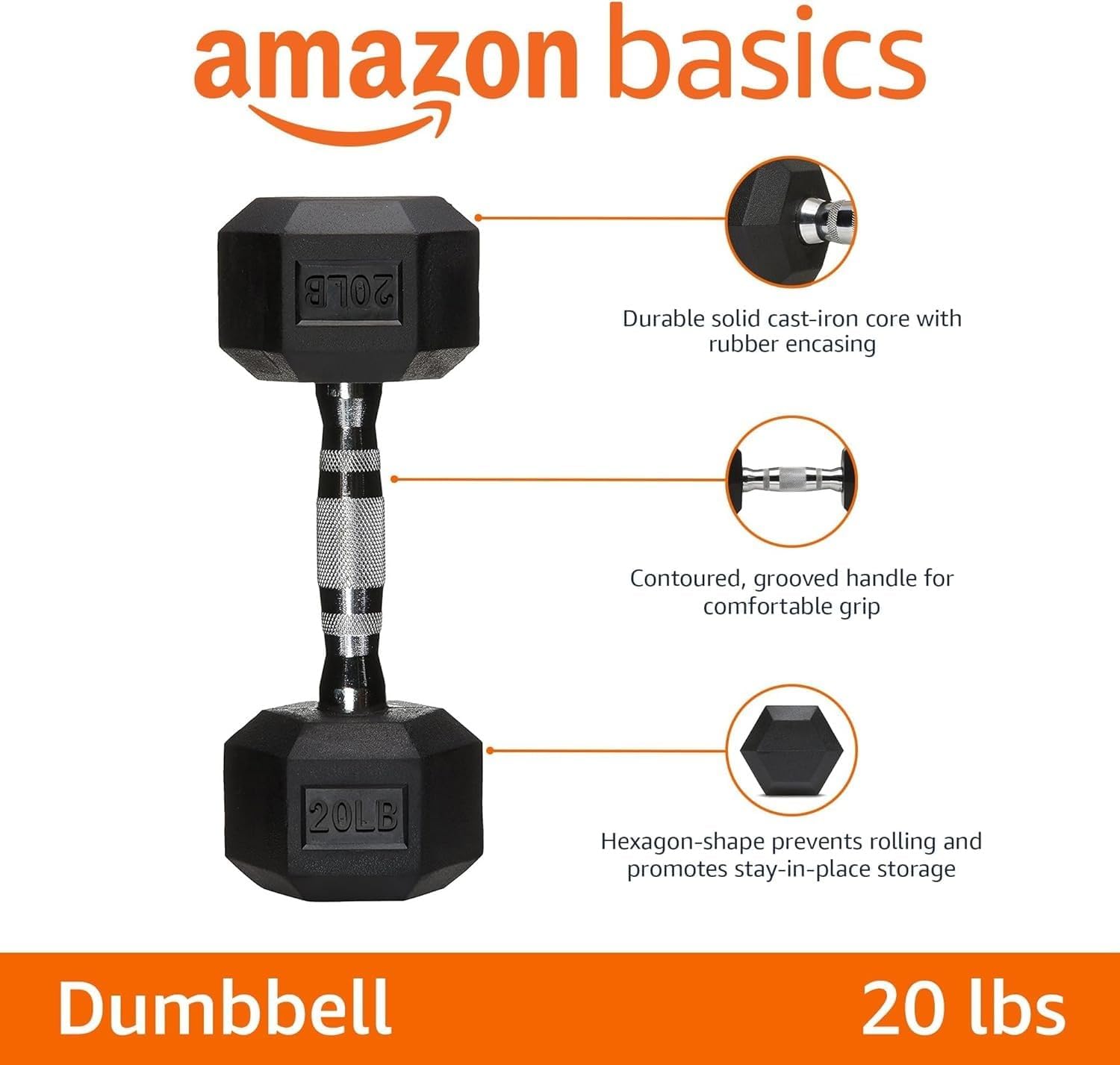
If you’ve ever stood in a sporting goods aisle trying to figure out whether a 25-pound dumbbell at $1.89 per pound is a better deal than a 50-pound pair at $1.42 per pound — or whether buying a full set all at once beats adding pairs as you get stronger — you’re already doing the right kind of thinking. Rubber hex dumbbells are exactly what they sound like: free weights coated in rubber (which protects your floors and quiets the clank), shaped with flat hexagonal ends so they don’t roll away mid-set. They’re the backbone of countless home gyms. This article breaks down the per-pound pricing math that separates a smart purchase from an expensive impulse buy, and gives you a clear framework for deciding which set configuration — a single pair, a pairs bundle, or a complete set spanning light to heavy — actually fits how you train.
Why Per-Pound Price Is the Right Unit of Comparison (And Where It Breaks Down)
The fitness industry has a habit of marketing dumbbell sets by sticker price: “Complete set, $299!” That number is almost meaningless without knowing total poundage. The honest comparison unit is cost per pound of iron — total purchase price divided by total weight in the box.
As of mid-2026, the rubber hex dumbbell market has settled into a fairly predictable price band, based on patterns documented in Garage Gym Reviews’ ongoing buyer’s guide and BarBend’s 2025 rubber hex roundup:
By the numbers:
| Set type | Typical price range | Approx. $/lb |
|---|---|---|
| Single pairs (5–20 lb) | $0.90–$1.60/lb | Higher per-lb cost |
| Mid-range sets (5–50 lb) | $1.20–$1.65/lb | Mid-range sweet spot |
| Full commercial sets (5–100 lb) | $1.10–$1.45/lb | Bulk discount kicks in |
| Budget no-name (pairs only) | $0.75–$1.10/lb | Widest quality variance |
The per-pound metric works well when you’re comparing apples to apples — same rubber coating quality, same handle diameter, similar knurling (the textured grip pattern machined into the handle). It starts to mislead you when quality diverges. A $0.90/lb set from an unknown brand and a $1.50/lb set from a manufacturer with documented commercial-grade rubber compounds are not the same product at different price points — they’re different products that happen to share a measurement unit.
Verywell Fit’s home gym budgeting overview makes this point explicitly: the lowest per-pound price frequently correlates with rubber that off-gasses (releases a strong chemical smell for weeks or months), handles that are cast slightly off-center, and weight stamping that rounds aggressively — sometimes 5–8% light on actual iron content. Those aren’t catastrophic problems for casual use, but they matter if you’re programming progressive overload precisely or using the weights daily.
The working rule: use $/lb to filter out sets that are clearly overpriced for their tier, then evaluate build quality within the tier. Don’t let a favorable $/lb number override legitimate red flags in the review record.
How Set Configuration Changes the Math
The single most common mistake intermediate home-gym buyers make is purchasing only the weights they need right now. ACE Fitness’s resistance training guidelines note that progressive overload — the practice of systematically increasing resistance over time — is the primary driver of strength adaptation. That means the weights you need in six months are already a predictable purchase. Buying ahead of that curve almost always wins on total cost.
Here’s how the configuration decision actually plays out:
Buying pairs incrementally. If you start with a 15 lb pair and add pairs every few months, you’re paying the single-pair premium each time — typically $1.40–$1.60/lb — and absorbing shipping costs on multiple orders. Over 18 months of progressive training, Garage Gym Reviews’ price tracking suggests you’ll frequently spend 20–30% more in total than if you’d bought a bundled set upfront that spanned the same weight range.
Buying a fixed set (e.g., 5–50 lb in 5 lb increments). This is the classic home-gym entry point. A 5–50 lb set in 5 lb increments gives you 10 pairs — 550 total pounds of iron. At mid-2026 mid-range pricing (~$1.35/lb), expect to pay $720–$800 for a reputable set. BarBend’s 2025 roundup documents several well-reviewed sets in this category landing between $650 and $850 depending on brand and rubber compound quality.
Buying a full range (5–100 lb). This is where the per-pound math gets genuinely attractive, and where the decision frame shifts. A 5–100 lb set in 5 lb increments is 20 pairs — roughly 2,100 lbs of iron. At $1.15–$1.40/lb, total investment runs $2,400–$2,940. That sounds large, but for a serious home-gym athlete who expects to use the upper-weight pairs within 2–3 years, the per-pound cost is lower than buying the same weights piecemeal. The math favors full sets for dedicated trainees; it penalizes them for people who realistically cap out at 40–50 lbs.
The decision rule:
- If your honest working weight range today spans more than 30 lbs (e.g., you use 20s for some movements and 50s for others), a bundled set almost always beats incremental buying on total cost.
- If you’re genuinely a beginner capping out under 30 lbs, buy a targeted 3–4 pair bundle and revisit in 12 months.
- If you’re outfitting even a small studio or coaching space with multiple sets for client use, per-pound math strongly favors full-range commercial sets — and warranty coverage becomes the second filter, not price.
Rubber Compound Quality: The Variable the Math Ignores
Per-pound pricing tells you nothing about rubber durability, and rubber durability is where rubber hex dumbbell sets actually diverge in long-run value.
There are two dominant rubber types in this market: virgin rubber and recycled rubber (crumb rubber). Virgin rubber is compounded from raw materials specifically for the application; it’s denser, more consistent, and far less prone to cracking, flaking, or off-gassing. Recycled crumb rubber is made from repurposed material (most often recycled tires) and costs less to produce — which is how budget sets hit $0.80–$0.90/lb and still turn a margin.
Owners in long-run reviews documented by both Garage Gym Reviews and BarBend consistently report that crumb-rubber coatings on no-name sets begin to show surface cracking within 12–18 months of regular use, particularly at the neck where the rubber meets the steel handle. Virgin rubber coatings from reputable manufacturers — the reviewer community specifically calls out Cap Barbell’s commercial line, Rogue’s rubber hex offerings, and Rep Fitness’s sets as benchmarks — hold up notably better over the same period, with owners reporting minimal degradation at 3+ years of daily use.
Wirecutter’s dumbbell guide (updated 2025) flags the handle-to-collar bond as the most common failure point across the category. A handle that spins or loosens over time isn’t just annoying — it introduces a genuine injury risk during loaded exercises. Their recommendation: look explicitly for sets where owner reviews address long-term handle integrity, not just initial impressions.
What this means for your math: if a budget set at $0.90/lb needs to be replaced in 18 months while a mid-range set at $1.40/lb runs 5+ years, the effective cost-per-year on the budget set is often higher. The per-pound price comparison is a snapshot; total-cost-of-ownership over a realistic use horizon is the actual number that matters.
Storage Footprint and the Hidden Cost of “Full Sets”
One more variable the $/lb calculation skips: space. A complete 5–100 lb rubber hex set requires a dedicated rack — typically a 3-tier horizontal rack running 60–72 inches wide and 24–30 inches deep. That’s meaningful floor space in a garage gym or spare room. The rack itself, if purchased separately, adds $150–$350 to the total investment (Garage Gym Reviews documents this range for weight-rated commercial A-frame and flat-tier racks as of early 2026).
Some buyers solve this by purchasing sets that include a rack — several manufacturers bundle them — which often reduces total outlay versus buying separately and simplifies the storage equation. BarBend’s roundup notes that bundled-rack pricing is typically $50–$100 less than buying components separately from the same brand, though that advantage narrows when you can find a standalone rack on sale.
For home-gym buyers with genuine space constraints, this is where the adjustable dumbbell argument re-enters the conversation. But that’s a separate analysis. For rubber hex sets specifically, build the rack cost into your per-pound math if you’re buying a full set and don’t already own appropriate storage.
The Decision Frame: If X, Then Y
Here’s where the research lands, translated into actionable rules:
If you’re buying your first set and your working weight range is under 40 lbs: Target a 5–40 lb set in 5 lb increments. Expect to pay $1.20–$1.50/lb from a reputable brand. Avoid sub-$0.95/lb options — the long-run replacement risk erodes the savings.
If your range spans 40–75 lbs and you’re committed to progressive training: A 5–75 lb set is the sweet spot for total cost-of-ownership. Prioritize brands with documented handle integrity in long-run owner reviews (Cap Barbell commercial, Rep Fitness, Rogue) over unknown imports at lower $/lb.
If you’re outfitting a coaching space or small studio: Full-range commercial sets (5–100 lb) at $1.15–$1.40/lb pencil out better than piecemeal purchases within 2 years. Warranty documentation and commercial-use rating matter more than sticker price — a set rated for commercial daily use typically has handle-bond specs and rubber compound grades the manufacturer will document on request.
If you see a $/lb price below $0.90 from an unfamiliar brand: That’s not necessarily a deal-breaker, but go looking specifically for owner reviews at the 12–24 month mark, not just 30-day post-purchase impressions. Crumb-rubber degradation and handle loosening show up on that timeline, not at first use.
The per-pound framework is the right starting lens — it cuts through marketing noise quickly. But it earns its keep when you layer in rubber quality, handle durability over time, storage costs, and an honest read of where your training ceiling actually sits. Run all four numbers, and the right set usually becomes obvious.